Personal, Social, Health and Economic (PSHE) Education, including Relationships and Sex Education
Intent
At Parkside Community College, we are passionate about providing our students with a well-rounded spiral and sequenced curriculum that incorporates the hidden skills and knowledge that will help our students nurture their own personal development. Today’s young people are growing up in an increasingly complex world. This presents many positive and exciting opportunities but also challenges and risks. In this environment, young people need to learn how to be safe and healthy, and how to manage their academic, personal, and social lives in a positive and balanced way.
PSHE
Personal, Social, Health, Careers Education (PSHE) education is a subject that supports our students to be healthy, safe and prepared for modern life. It is a subject in which our students will develop the knowledge, skills, and attributes they need to manage their lives, now and in the future.
RSHE
Relationships, Sex and Health education (RSHE) is taught as part of PSHE. The aim of RSE is to teach our students to understand human sexuality and to respect themselves and others. Other aspects of RSHE cover the following areas of Healthy living:
PSHE also incorporates aspects of Careers, finance, citizenship, equality and diversity and British values.
PSHE education is a school curriculum subject through which pupils develop the knowledge, skills, and attributes they need to keep themselves healthy, safe and prepared for life and work. When delivered well, PSHE education has an impact on both academic and non-academic outcomes for pupils, particularly the most vulnerable and disadvantaged.
The majority of PSHE education became compulsory in all schools in September 2020 with the introduction of statutory Relationships Education at key stages 1 and 2, Relationships and Sex Education (RSE) in key stages 3 and 4, and Health Education from key stage 1 to 4.
PSHE education was already a requirement in independent schools. PSHE education addresses both pupils’ current experiences and preparation for their future. The Programme of Study therefore provides a spiral curriculum to develop knowledge, skills, and attributes, where prior learning is revisited, reinforced, and extended year on year. This is grounded in the established evidence base for effective practice in PSHE education. Our Programme of Study identifies a broad range of important issues, but essentially prioritises quality over quantity (so that PSHE lessons are not simply a series of one-off, disconnected sessions) whilst ensuring that our programme reflects the universal needs of all children and young people, in our school. Unlike many other subjects, much of the specific knowledge taught in PSHE education changes regularly, for example because of legal changes, medical or technological advances. We review all information used to develop pupils’ knowledge on any aspect of PSHE education regularly to check that it is up to date, accurate, unbiased, and balanced.
Some aspects of the KS3 Computing curriculum are taught through KS3 PSHE lessons.
Statutory post-14 religious education is taught through the PSHE (RSE) + RE lessons at KS4.
Citizenship is also taught through the PSHE programme from KS3 to KS4.
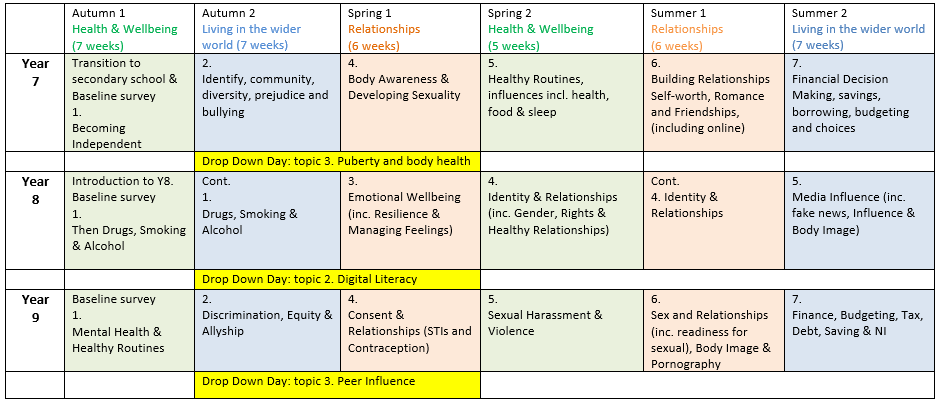
Key Stage 3
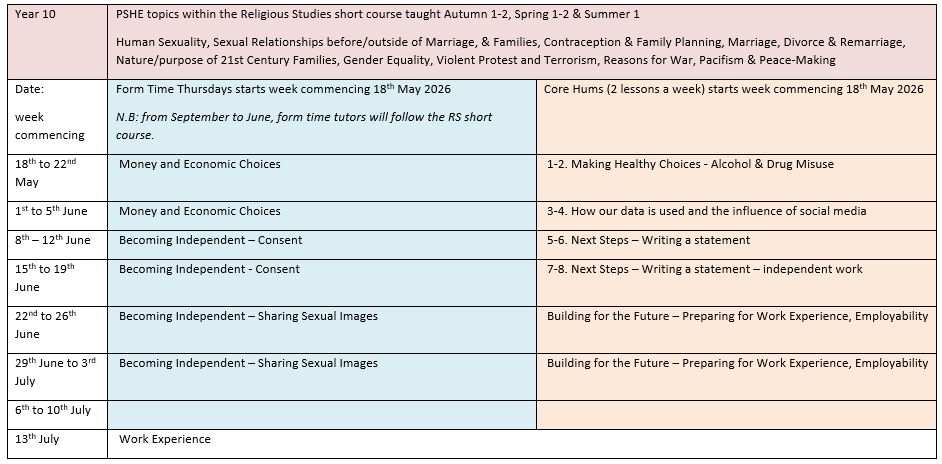
Key Stage 4
For further information about PSHE, please contact:
Mark Turner: mark.turner@parksidecc.org.uk